What Is an Anonymous Proxy? How It Works, Types & Uses
An anonymous proxy hides your real IP. Learn how it works, the three anonymity levels, and why sites can still spot one.
Valentin Ghita
Technical Writer, Marketing, Research
Mihalcea Romeo
Co-Founder, CTO
TL;DR: The short version
- An anonymous proxy passes your traffic through a middle server, so sites see that server's IP instead of yours.
- There are three levels. Transparent barely counts, since it still hands over your identity. Anonymous and elite are the two that actually hide you.
- Residential and mobile IPs are the hardest to catch, because they're real networks rather than a rack in a datacenter.
- It's not foolproof. A site can still spot a proxy from its IP reputation, sloppy headers, or the way the traffic behaves.
- Free proxies are the real risk. A lot skip HTTPS entirely, plenty are logging everything you do, and some are flat-out malware.
What Is an Anonymous Proxy?
An anonymous proxy is a server that hides your real IP address and strips the identifying details out of your requests, so the sites you visit can't tie the traffic back to you. "Anonymous" here is a behavior, not a product you buy. Any proxy can do it, whether the IP is residential, datacenter, or mobile, as long as it masks your address and doesn't leak anything that gives you away.
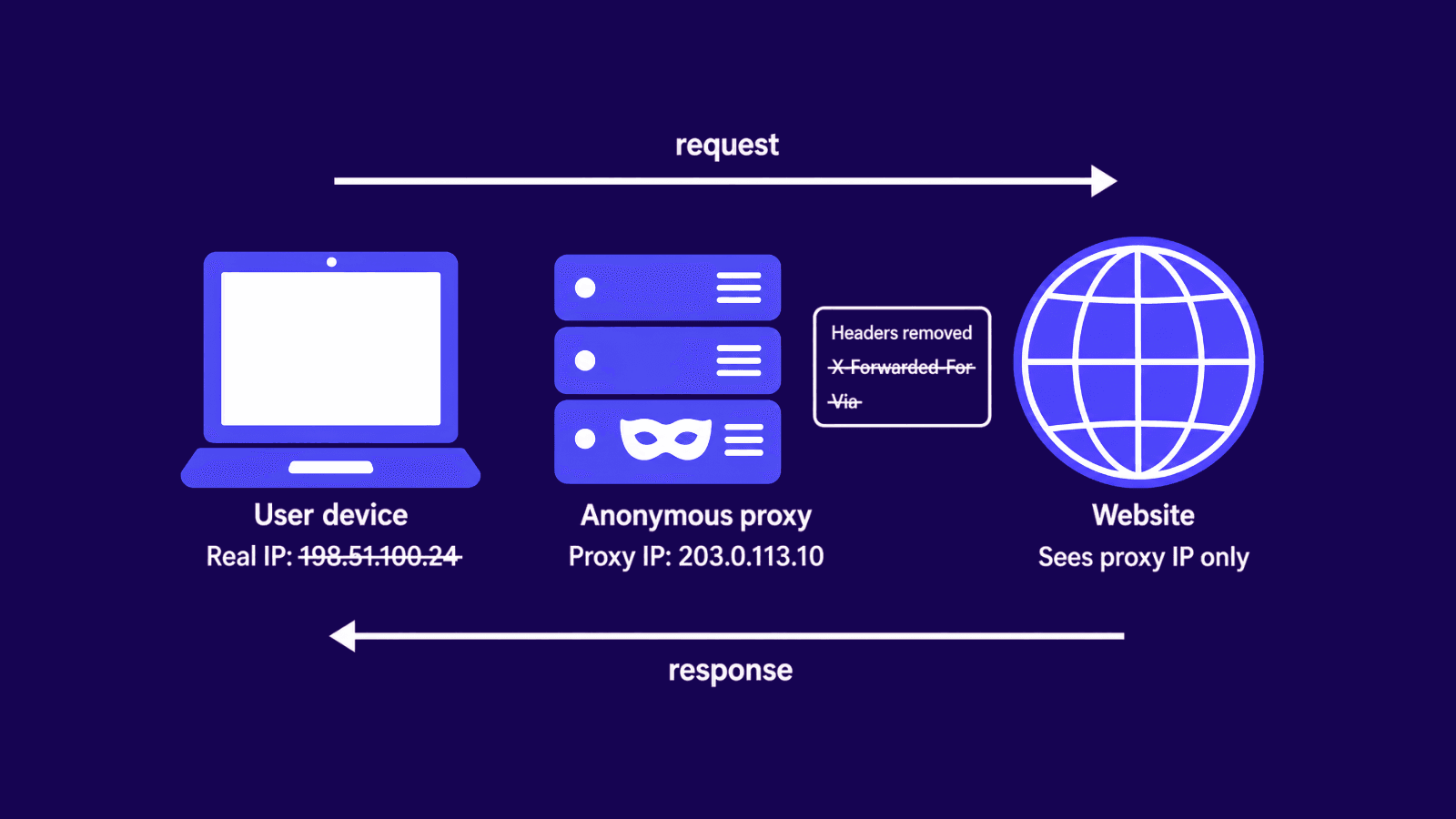
The difference between an anonymous proxy and an ordinary one is what happens to your request before it leaves. Both forward it to the site. An ordinary proxy sends it along as is. An anonymous one cleans it first, dropping the forwarding headers that would otherwise carry your IP or flag that a proxy is involved. So the site sees a plain request from the proxy and nothing else.
Just how hidden you are depends on the proxy's anonymity level. One heads-up before you get there: one of those levels is also called "anonymous," so the same word ends up doing two jobs. In this section it means the behavior. Later it's the name of a specific level.

Buy Rotating Residential Proxies
Real homeowner IPs that rotate on every request. Near-zero block rates for scraping and automation.
How Does an Anonymous Proxy Work?
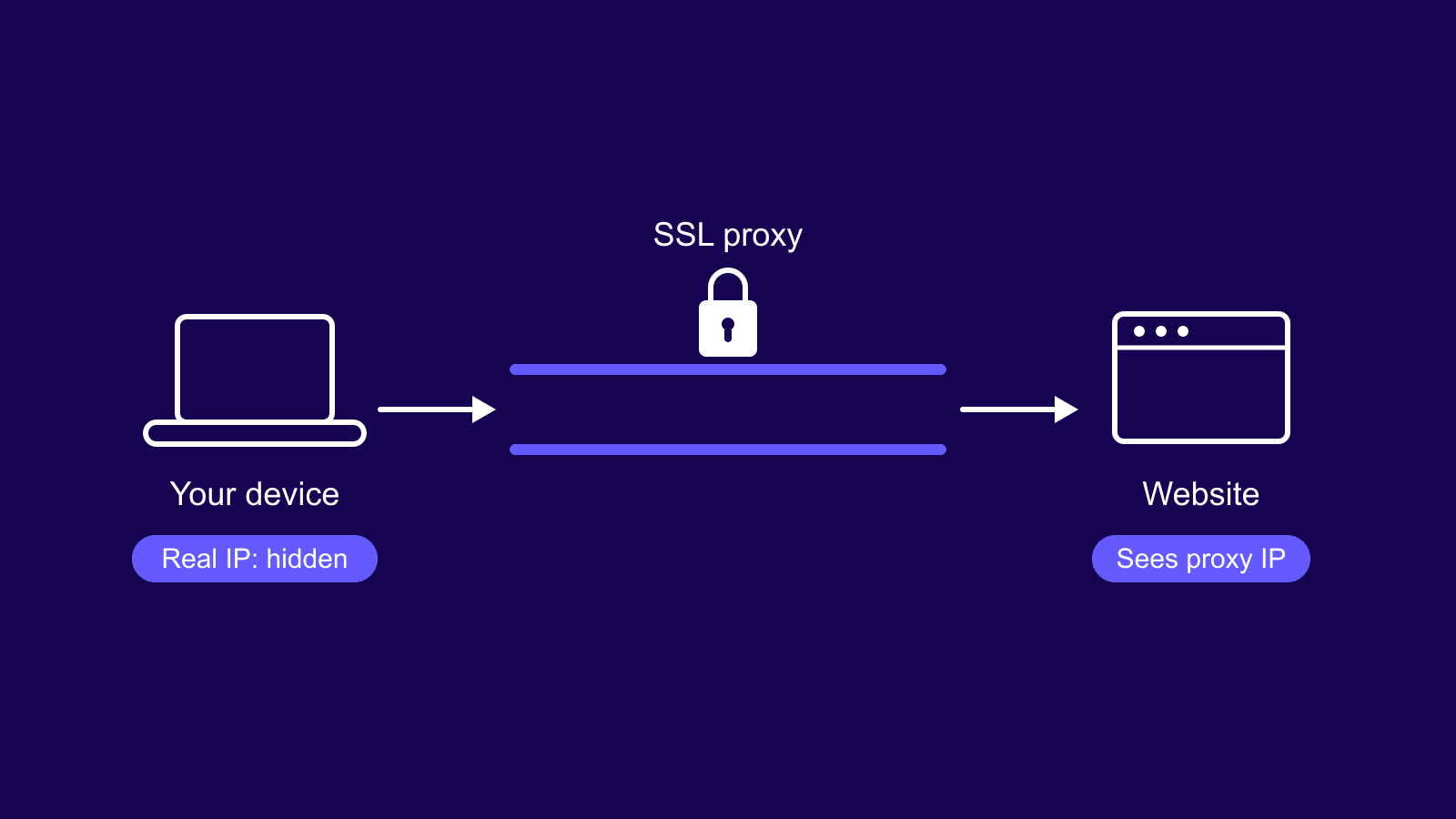
An anonymous proxy sits between your device and the site you want to reach. Your request never goes straight there. It reaches the proxy first, the proxy makes the request on your behalf, and the response comes back the same way. As far as the site can tell, the visit came from the proxy, so your real IP and its location stay hidden.
The privacy part happens just before that forward step. A good proxy edits or strips the headers that would reveal your IP or show that a proxy is in the chain. A bad one passes them through untouched and exposes you. That handling of the headers is what the three anonymity levels measure.
The Three Levels of Proxy Anonymity
Not every proxy hides you to the same degree, and it really comes down to two request headers. X-Forwarded-For can carry your real IP. Via flags that a proxy relayed the request. What a proxy does with those two headers is what sorts it into one of three tiers.
| Proxy type | Hides real IP | Sends Via header | Sends X-Forwarded-For | Detectable as a proxy |
|---|---|---|---|---|
| Transparent | No | Yes | Yes, with your real IP | Yes |
| Anonymous | Yes | Yes | Yes, without your real IP | Yes |
| Elite | Yes | No | No | No |
Transparent Proxies
A transparent proxy hides nothing. It drops your real IP into X-Forwarded-For and names itself in Via, so the site gets both your address and the fact that you're behind a relay. These exist for caching and content filtering on networks like offices and public Wi-Fi, not for privacy. For anonymity, it is the wrong tool.
Anonymous Proxies
An anonymous proxy removes your real IP, so the site sees the proxy's address instead. But it leaves the Via header in place, which still tells the destination that a proxy is involved. For a lot of sites, that is reason enough to throw a challenge or block you. You gain cover for your address, not for the fact that you are using a proxy.
Elite (High-Anonymity) Proxies
An elite proxy is the opposite. It hides your IP and removes the headers that would out it as a proxy, so the request looks like it came straight from an ordinary device. It's the only tier that holds up to a basic header check, which is why serious work tends to run on it. SOCKS5 proxies are a popular pick here, since the SOCKS5 protocol adds no proxy-identifying HTTP headers in the first place. For logged-in accounts and checkout flows, elite is effectively the floor, because any proxy signal there tends to trigger a block.
Which Proxy Types Deliver the Best Anonymity?
Anonymity level is about headers. IP type is about whether sites trust the address in the first place. The two work together, and for most tasks the IP type is what gets you blocked or waved through. The choices run from residential proxies to datacenter IPs, with mobile and ISP addresses sitting in between. They trade off in a predictable pattern, where more trust usually costs more and runs slower.
| Type | Trust | Speed | Cost | Block risk |
|---|---|---|---|---|
| Residential | High | Medium | High | Low |
| Mobile | Highest | Medium | Highest | Lowest |
| ISP | High | High | Medium | Low |
| Datacenter | Low | Highest | Low | High |
Residential and Mobile Proxies
Residential IPs are handed out by internet service providers to home users, so sites treat them as regular visitors. Mobile IPs come from cellular carriers and score even higher, because a carrier shares one small pool of addresses across thousands of real people, and blocking that pool means blocking real customers. When a target is strict, these are the IPs you want. Our rotating residential proxies pull from a large pool and change IPs automatically, so each request can land from a different home address. For the toughest targets, mobile proxies carry the kind of carrier trust that anti-bot systems rarely question.
ISP Proxies
ISP proxies are static residential IPs hosted in a datacenter. You get the trust of an ISP-assigned address with datacenter speed, and the IP does not change between requests. That makes them a fit for long sessions on sensitive sites where you also need throughput. For a closer look at the trade-offs, see how ISP and datacenter proxies compare.
Datacenter Proxies
Datacenter proxies come from server providers, not consumer networks. They are the fastest and cheapest option and do fine on sites that do not inspect where an IP comes from. The catch is detectability. Their address ranges are public, so strict targets spot and block them quickly.
What People Use Anonymous Proxies For
Web Scraping and Data Collection
Scraping at any real scale means firing a lot of requests at the same site. Coming from one IP, that pattern hits rate limits and bans fast. Spread the same requests across many addresses and the traffic looks like a crowd of separate visitors. Price monitoring, search ranking checks, and competitor research all lean on this. The practical rule is to rotate often enough that no single IP carries a suspicious share of the volume, and to throttle requests to a pace a real browser could match.
Ad Verification and Market Research
Ads and prices shift by location, so checking them means seeing the page the way a local does. An anonymous proxy lets you load a rival's pricing or a specific ad placement from any market, without flagging that a competitor is the one looking.
Bypassing Geo-Restrictions and Censorship
Some content is locked to specific countries. Some networks block whole categories of sites outright. Either way, routing through a proxy in a region that allows the content gets you back in. The harder case is a heavily filtered network, where a plain proxy usually gets spotted and blocked. That's where encryption earns its keep. Shadowsocks disguises proxy traffic so it slips past deep packet inspection, which is what keeps it running on networks that shut ordinary proxies down.
"Anonymous Proxy Detected": Why Sites Spot Proxies
Seeing "anonymous proxy detected" means a site noticed your connection is being relayed. It does not mean the proxy broke. Three signals do most of the detecting.
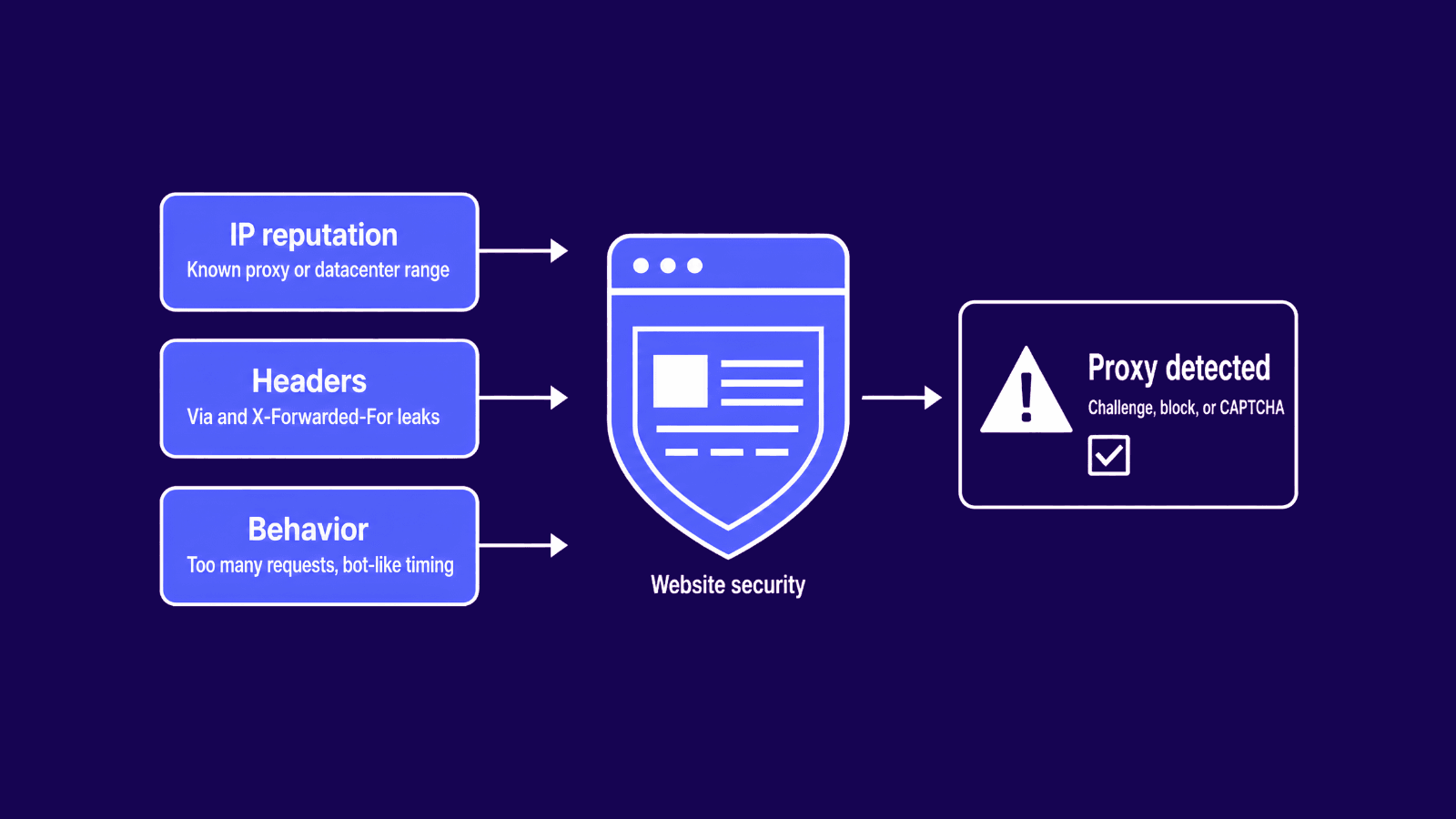
IP reputation is the first. Security vendors keep blocklists of known proxy and datacenter ranges, and if your IP is on one, the site flags it before you click anything.
Headers are the next tell. A proxy can leave traces in fields like Via and X-Forwarded-For, either of which can show that a relay handled the request. Elite proxies strip those fields. Lower tiers leave them in.
Then there's behavior. Hundreds of requests a minute, timing that's too regular to be human, clicks landing faster than anyone could actually move a mouse: all of it reads as a bot no matter how clean the IP is.
The fix doesn't change much from case to case. Run elite proxies on residential or mobile IPs and keep your request rate reasonable. If you trip the block mid-session, switch to a fresh IP and clear the site's cookies before you try again, because a flagged session can stick to both. For the full set of methods sites use, see how websites detect proxy servers.
Anonymous proxy vs VPN
Proxies and VPNs both change the IP a site sees, but they work differently. An anonymous proxy reroutes the traffic from a single app or browser, and usually leaves it unencrypted. A VPN wraps everything on your device in an encrypted tunnel.
That difference is what decides between them. A proxy is lighter and much easier to spread across hundreds of IPs, which is why scraping and multi-account work lean on it. A VPN covers all your traffic and hides it from your ISP or network, so it's the better pick when you just want everyday privacy. Our proxy vs VPN guide goes into more detail. The split is easy to see side by side.
| Factor | Anonymous proxy | VPN |
|---|---|---|
| Encryption | Usually none | Full tunnel |
| Scope | One app or browser | Whole device |
| Speed | Faster, less overhead | Slightly slower |
| Best for | Scraping, multi-account, geo-access | Everyday privacy, securing all traffic |
Free vs Paid Anonymous Proxies: The Real Risks
Free anonymous proxies look like a bargain and charge you in other ways. Plenty do not support HTTPS, so your traffic moves in the clear. Most are packed with thousands of other users, which means the IPs are already worn out and blocklisted. Some operators quietly log your activity and sell it. A share of them exist only to push malware or scrape your data, full stop.
Paid providers run clean IP pools, rotate addresses on demand, hold uptime high, and support secure protocols. When the work matters, a reliable provider costs less than one leaked session or one banned account.
Conclusion
Match the proxy to the job. Work out how much anonymity the target really demands, then pick the tier and IP type that clear that bar. Strict sites, logins, and checkouts want elite proxies on residential or mobile IPs. High-volume work on relaxed sites runs fine on cheaper, faster datacenter IPs. Anything sensitive on an open or filtered network needs encryption on top.
No proxy makes you invisible, and any provider that promises otherwise is overselling. The right setup gets you close and, just as important, keeps you unblocked. If you are not sure which type fits your case, our support team can point you to the right one before you spend anything.
Frequently asked questions
Frequently Asked Questions
Is it legal to use an anonymous proxy?
In most countries, yes. Routing your traffic through another IP isn't illegal by itself; what you do with it is the part that matters. Scraping public data, checking your ads, getting at geo-locked content, all generally fine. Running fraud through it or breaking a site's terms is not.
Are anonymous proxies safe to use?
A paid proxy from a reputable provider is. Free ones are where it goes wrong. Plenty have no encryption, quietly log your traffic, or come bundled with malware. If you're choosing one, stick to providers that support HTTPS or SOCKS5 and actually own their IP pool.
Can websites still detect an anonymous proxy?
They can. Hiding your IP doesn't close every door, sites still read IP reputation, leftover request headers, and traffic that doesn't look human. The hardest setups to catch are elite proxies running on residential or mobile IPs.
Does an anonymous proxy make me completely anonymous?
No, and it's worth being clear about the limit. It hides your IP and location from the sites you visit, but it won't encrypt everything, and it does nothing about cookies or browser fingerprinting. If you want your whole connection covered, pair it with a VPN or use a secure protocol.
Do anonymous proxies hide my activity from my ISP?
Usually not. A standard proxy reroutes a single app and leaves the connection unencrypted, so your ISP can still see where you're going. Hiding that takes a VPN or an encrypted proxy protocol.
How is an anonymous proxy different from incognito mode?
They're not really doing the same job. Incognito just stops your browser from saving history and cookies on your own device; your IP doesn't change, and both your network and the site still see your real address. A proxy is what changes the IP the site sees.
Which proxy type gives the highest anonymity?
Mobile first, residential close behind. Both pull their IPs from real networks that sites already trust, so they rarely get flagged. Datacenter proxies are faster and cheaper, but a lot easier to spot.
What's the difference between the "anonymous" tier and an elite proxy?
An anonymous-tier proxy hides your real IP but still leaves header signals that a proxy is involved, so a site can spot and block it. An elite proxy hides the IP and strips those signals, so the request looks like it came straight from you. Elite is the higher of the two.